
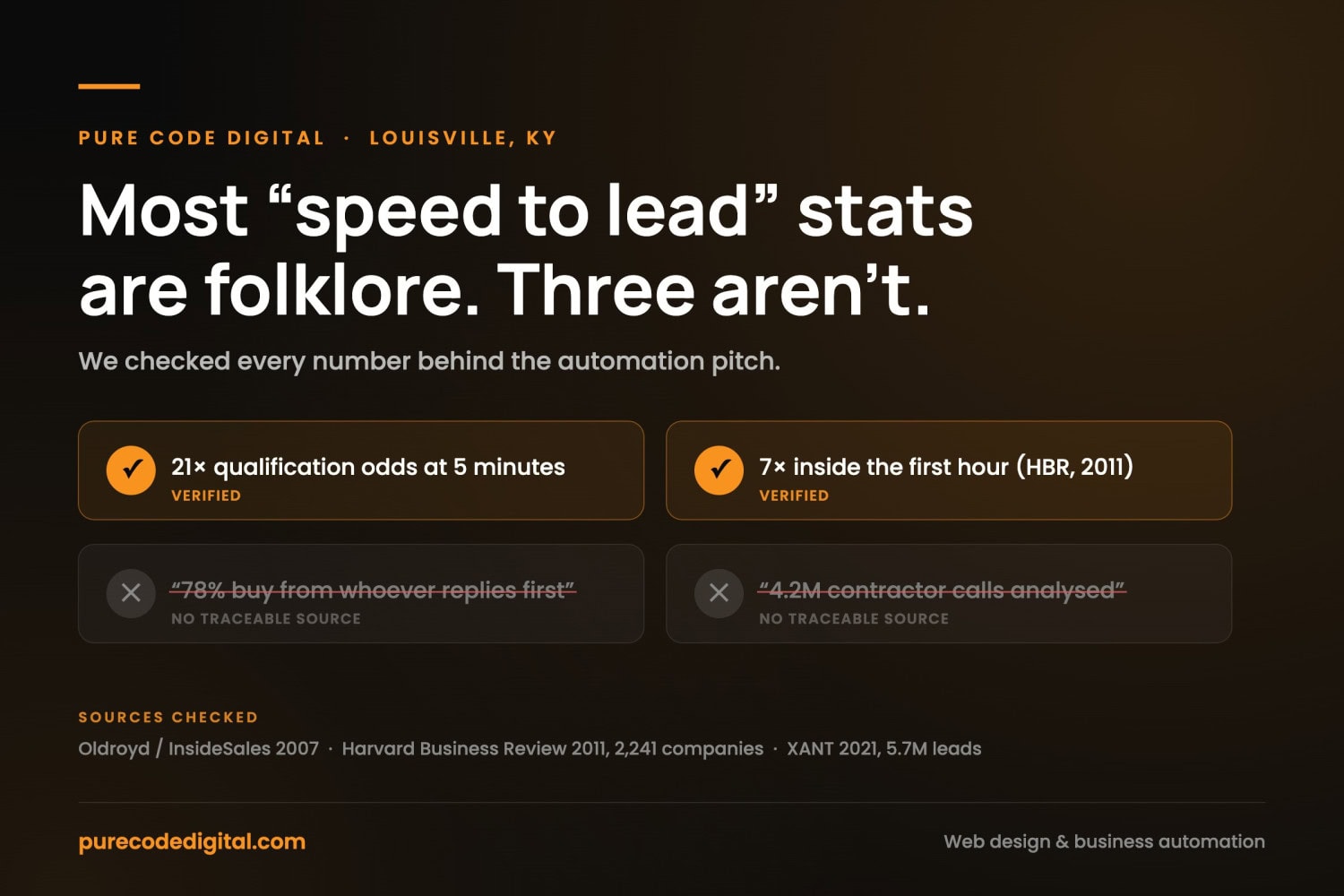
Every pitch for lead automation opens with the same handful of statistics. You are twenty-one times more likely to qualify a lead if you respond within five minutes. Seventy-eight percent of customers buy from whichever company replies first. One widely shared report supposedly analysed 4.2 million contractor phone calls. We had seen those figures often enough that we assumed they were settled fact, and when we sat down to write this piece we went looking for the original studies so we could cite them properly.
Some of them are real, and better than we expected. Others turned out to be untraceable, and at least one appears to have been invented by an AI and then repeated until it looked like research. Since we build this kind of business automation for a living, and since our clients make spending decisions partly on the strength of these numbers, it seemed worth separating the two before getting to any advice.
Where the five-minute rule actually comes from
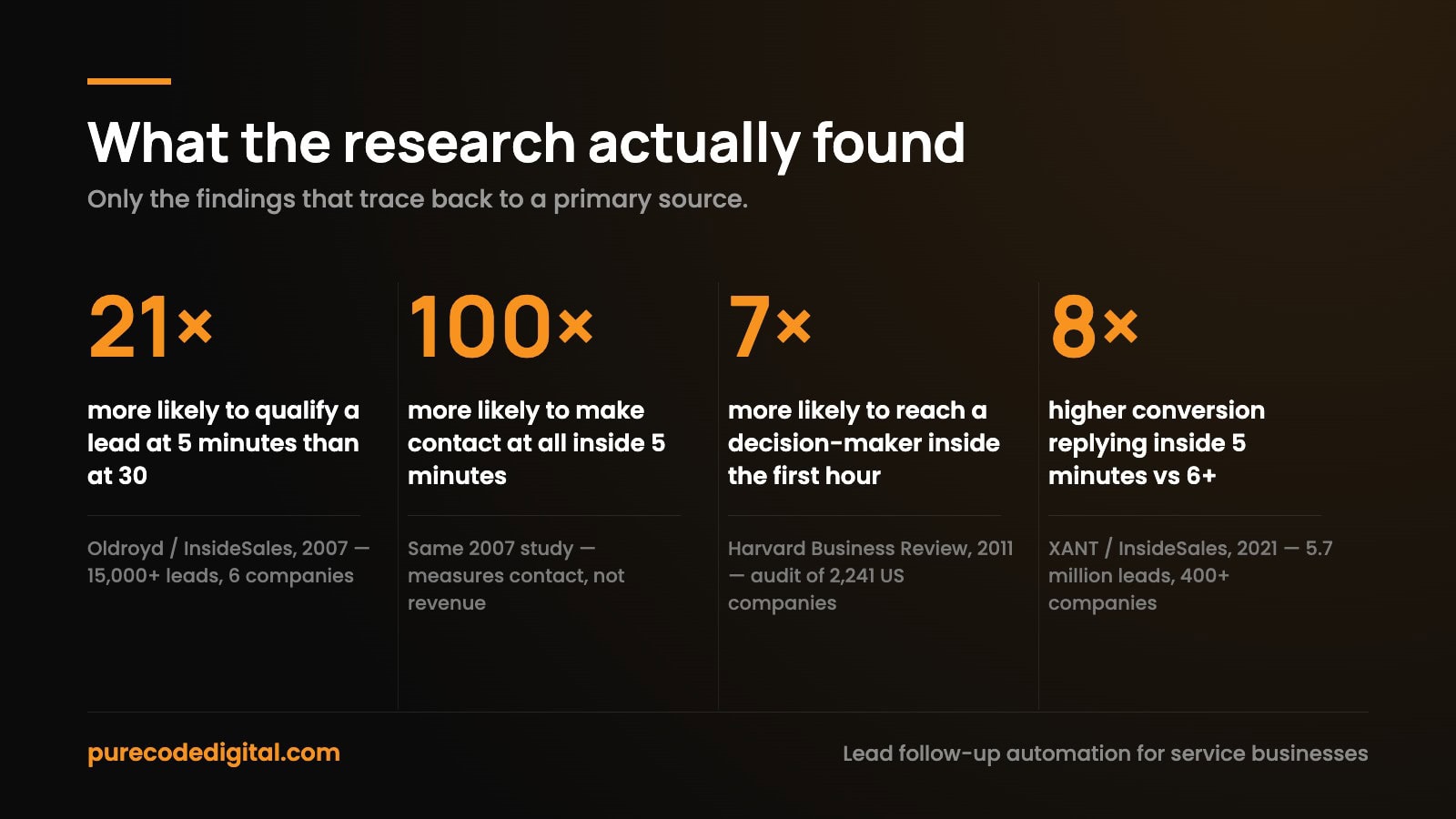
The foundation of nearly every speed-to-lead argument is a study conducted by Dr James Oldroyd with InsideSales in 2007. It looked at three years of platform data covering more than fifteen thousand leads across six companies, and it found that leads contacted within five minutes were roughly twenty-one times more likely to be qualified than those contacted at the thirty-minute mark, and about a hundred times more likely to be reached at all.
That is a genuine finding, and it is worth reading carefully. The study measured contact and qualification. It did not measure closed deals or revenue, which means the honest version of the claim is that replying quickly helps you reach people while they are still sitting at their computer thinking about the problem. It is not a guarantee that speed makes you money, and anyone selling you software on that basis is stretching the research further than it goes.
A second study gives the finding more weight. In 2011, Oldroyd published an audit of 2,241 US companies with Kathryn McElheran and David Elkington in Harvard Business Review. Firms that responded inside an hour were around seven times more likely to have a substantive conversation with a decision-maker than firms that waited a single hour longer. That same audit produced the 42-hour average response time that gets quoted constantly, usually misremembered as 47 hours.
The pattern held up again a decade later, when XANT looked at 5.7 million leads across more than four hundred companies in 2021 and found roughly eight times higher conversion for replies inside five minutes compared with six minutes or later. Three separate datasets, gathered fourteen years apart by different people, all pointing the same direction. In marketing research that counts as unusually solid ground.
The numbers that fall apart when you check them
The claim that seventy-eight percent of customers buy from the company that responds first is quoted in hundreds of articles, almost always credited to something called a Lead Connect survey. There is no published methodology behind it, no stated sample size, and no accessible original document. The closely related claim that between thirty-five and fifty percent of sales go to whoever replies first is usually attributed to InsideSales, but it does not appear anywhere in their published research either. Both have been catalogued as unsourced folklore by people who went looking for the originals and came back empty-handed.
The missed-call statistic is stranger still, and it is worth telling in full because it says something about the state of this whole subject. HiGrovi published a roundup of existing research on missed calls in home services. Some time afterwards they discovered that search engines and AI assistants had begun citing a “HiGrovi Contractor Missed Call Report” that had supposedly analysed 4.2 million calls. To their credit they said so publicly: the figure is not theirs, they never collected it, and it appears to have been generated rather than reported. It is now circulating as a fact about an industry, attached to a company that has disowned it.
What can be said about missed calls, carefully, is less dramatic. Industry call analytics put the unanswered rate across home services somewhere in the region of twenty-seven percent. Fewer than three percent of callers who reach voicemail bother leaving a message, which means the overwhelming majority of missed calls leave no evidence behind at all. And somewhere between a quarter and forty percent of inbound calls arrive outside normal business hours, which will surprise nobody who has ever had a water heater fail on a Sunday evening. Those are directional numbers rather than precise ones, and we would rather say so than round them into something that sounds more persuasive.
What this means for a business that answers its own phone
Strip out the inflated figures and the practical conclusion survives, because it never depended on them in the first place. Somebody who fills in your contact form is almost certainly filling in two others, and their attention decays quickly. The gap that costs you work is rarely the difference between replying in five minutes and replying in fifteen. It is the difference between replying in twenty minutes and replying on Tuesday.
There is a second conclusion that automation vendors are less keen to mention. A great deal of what gets sold as AI lead automation is aimed at a problem you may not actually have. If you already answer your phone and reply to form submissions the same day, no platform is going to double your close rate. What it can do is close the specific gaps that stay open no matter how conscientious you are: the enquiry that lands at nine in the evening, the quote that went out three weeks ago and was never chased, the review you meant to ask for and forgot.
The after-hours acknowledgement
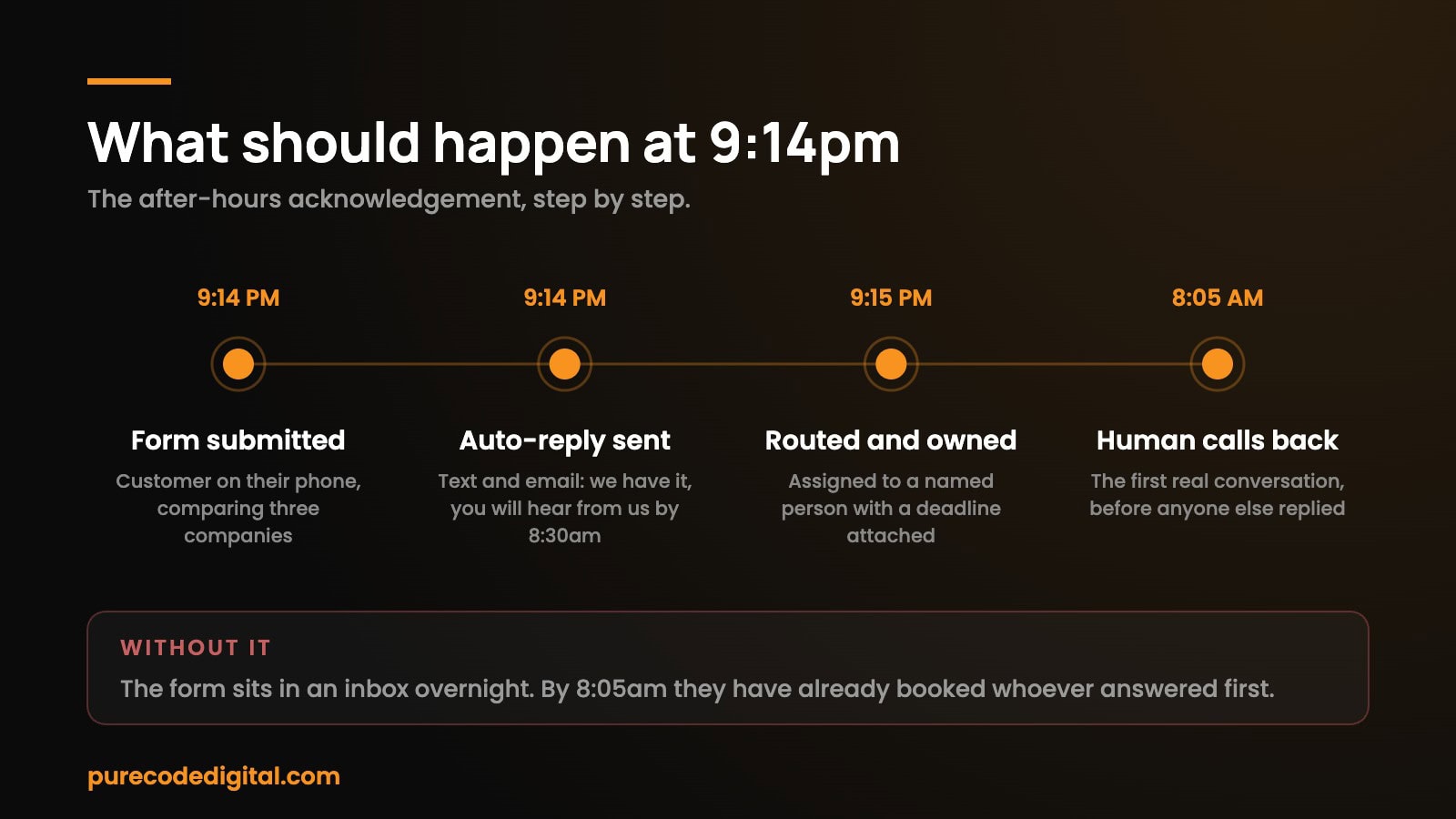
If you only ever build one automation, build this one. An enquiry that arrives at 9:14 in the evening triggers an immediate text message and email confirming you have it, telling the customer roughly when they will hear from a person, and giving them a number to call if the situation is genuinely an emergency. Nothing about it pretends to be a human reply, and it does not need to be.
The reason it earns its keep before anything else is that it works on enquiries you are currently losing without ever knowing they existed. You cannot follow up on a lead you never saw, and since almost nobody leaves a voicemail, most of those enquiries simply evaporate. An acknowledgement buys you the overnight hours. It takes an afternoon to build and costs effectively nothing to run.
Routing, quote chasing and the review ask
The next most useful thing you can automate is not a message at all, but ownership. Enquiries in most small service businesses arrive across a form inbox, a mobile phone, a Facebook page and occasionally a text message to whoever the customer met last. When every enquiry lands in one place and is assigned to a named person with a deadline, a good deal of what looked like a response-time problem turns out to have been an accountability problem. Automation will not fix that on its own, but it makes the gap visible, which is usually the harder half.
Quote follow-up is the third. A quote that goes out and hears nothing back gets a short nudge on day three, another on day seven, a last one on day fourteen, and then stops. You write the messages once, in your own voice, and the sequence switches itself off the moment somebody replies. This is also the automation most likely to be sitting unused inside software you already pay for, which is worth checking before you build anything.
The fourth is the review request, triggered a set number of days after a job is marked complete and containing a direct link rather than instructions. Review count and velocity remain among the strongest signals in local search rankings, and asking manually is invariably the task that slips when the week gets busy. If you already answer your phone reliably and you only have the appetite for one change this quarter, make it this one. Our note on why local SEO matters goes into what that does for visibility.
What lead follow-up automation costs in 2026
The connective tissue between your form, your phone, your calendar and your CRM comes from one of three platforms, and the pricing is public. We checked all of it in August 2026.
| Platform | Free tier | Entry paid plan | Worth knowing |
|---|---|---|---|
| Zapier | 100 tasks per month | Professional from $19.99/mo | Connects to the most apps, costs the most per task |
| Make | 1,000 credits per month | Core from $12/mo | Cheaper at volume, takes longer to learn |
| n8n | Community edition, self-hosted, free | Cloud Starter €20/mo, 2,500 executions | Self-host it and you pay only for the server |
For most local service businesses the entry tier is genuinely enough. The four automations described above will not come close to a hundred Zapier tasks a month unless you are fielding serious volume, and if you outgrow it, moving up a tier costs less than an hour of anyone’s labour. If you would rather not build and maintain the workflows yourself, that is the sort of thing our Zapier automation development work exists to cover.
Check what you already pay for first
Before any of that, look at the software already running your jobs. Jobber charges $49 a month for Core, $139 for Connect, $199 for Grow and $499 for Plus on monthly billing, with annual commitments bringing those down to $24, $80, $120 and $320. Automated quote and invoice follow-ups appear at the Connect tier. Custom workflow automations and two-way SMS appear at Grow. Housecall Pro, ServiceTitan and the rest have comparable ladders.
We mention this because a meaningful share of the automation work agencies get paid to build already exists, switched off, inside a subscription the client has been paying for since 2023. Turning it on is free. We would rather tell you that up front than invoice you for rebuilding it, and if it turns out your existing tool genuinely cannot do what you need, that is the point at which custom software starts to make sense rather than the starting point.
Where automation makes things worse
The first human reply on a large job should stay human. An acknowledgement is welcome and nobody minds one, but a message engineered to feel personal while being generated by a machine reads exactly like what it is, and the bigger the job the more that first real conversation matters.
Automating a process that is already broken only makes the breakage arrive faster. If quotes take nine days to leave your desk, a polite automated reminder that the quote is overdue simply tells the customer sooner that you are slow. Fix the nine days first.
There is also a growing enthusiasm for AI receptionists, and we would suggest trying the cheaper options before committing to one. Some businesses genuinely cannot answer the phone, because they are under a sink or on a roof, and for them an AI chatbot or voice agent can be the right answer. But a shared inbox with a clear rule, or a human answering service, costs less and fails more gracefully. Our walkthrough on building an AI chatbot with Zapier and ChatGPT covers what that involves if you want to try it yourself.
Finally, resist the urge to chase five minutes. The research is clear that the steep decline happens within the first hour, so getting from two days down to two hours captures most of the available benefit. Getting from two hours down to two minutes costs considerably more and returns considerably less.
Start with one leak
Pick the gap you already know about. If enquiries arrive overnight, build the acknowledgement. If quotes go quiet, build the follow-up sequence. If your Google reviews have been stuck in single figures for two years, build the review request and leave everything else until next quarter. One automation that actually runs is worth more than four that were configured once, admired briefly, and never checked again.
We are Pure Code Digital, a web design and development studio in Louisville, Kentucky, and business automation is half of what we do. If you want a real figure for what any of this would cost against your particular setup, our quote tool will put an itemised price in your inbox in about two minutes. There is no sales call attached to it and no obligation afterwards.
Get an instant price for your project → or talk to us directly if you would rather describe it in person.